



General
It's not just you
Everything feels harder than it used to. You're not imagining it.
Sound familiar?
One quick check, and forty minutes are gone. Every story has a spin, and you’re left wondering who to believe. Nothing works like it used to.
Hundreds of contacts, but fewer close friends. Us versus them, about everything. Another crisis lands before you’ve recovered from the last, and there’s no time to think.
Everyone blames something: the phone, the news, politicians. But decades of data point to one pattern.
Attention, trust, friendship, time to think. The things we’d need to fix this are the ones running out.
Read the transcript
Cold open
You pick up your phone to check one thing.
Forty minutes later, you’re still scrolling. And you can’t remember a single thing you saw.
Every day, a new crisis. A war. A crash. A scandal. A warning. Before you’ve made sense of one, the next has already landed.
Half of what you read is spin. The rest, you can’t tell. So you stop trusting any of it.
Hundreds of contacts. Maybe thousands of followers. And at two in the morning, when it actually matters, almost nobody you’d call.
Wired, but exhausted. Always on, and never quite there.
It feels like driving through a storm while the windscreen fogs up. So you grip the wheel harder. And blame yourself for not seeing the road.
It isn’t just you. Something is happening to all of us at once. And from inside it, it’s almost impossible to see.
Three lines
77 per cent.
That’s how many Americans trusted their government to do the right thing, in 1964. By 2025: 17.
In 1990, 3 per cent of Americans had no close friends. By 2024: 17.
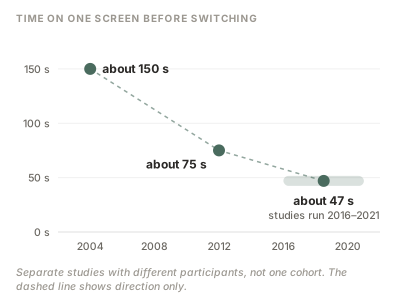
In 2004, people at work stayed on one screen for about two and a half minutes. In the latest studies: 47 seconds.
Pollsters. Friendship researchers. Attention scientists. Fields that never compare notes. All moving the same way.
Coincidence? Or a pattern?
Zoom out: nine threads
To see it, you have to step back. A long way back.
Each piece of this has been studied for decades. Almost nobody puts the pieces side by side. So we did.
Start with money and power. Three frameworks, built independently with different methods, one of them Ray Dalio’s, put the United States in a late, unstable phase of its cycle. Somewhere between the mid-2020s and the early 2030s.
Then the body. Running on constant alert wears down sleep, and the part of the brain that plans ahead.
Then the people around us. Americans aged 15 to 24 spent about 70 per cent less time with friends in person in 2020 than in 2003.
Then the shocks. 2008. 2020. After each one so far, trust has come back a little less.
A warming climate. Lives lived mostly indoors, away from the daylight our bodies set their clocks by.
And now AI, sitting inside some of our most personal conversations.
Two more threads we’ll come back to: a century of professional persuasion, and the technology that turned it into software.
And one that tests all the others: the record of when things got better.
Nine threads. Each one documented on its own. Side by side, they stop looking like nine problems. They start looking like one weave.
Which makes it tempting to find the one thing that caused it. Big tech. The government. The economy. Your generation, or the one before.
There isn’t one. The causes are tangled together. And the urge to find a single villain is part of the pattern.
The windscreen
Everything so far has been weather. Debt cycles. Shocks. Fewer friends. Bodies running on alert. A storm, building slowly, over decades.
But one thread in this picture is different. It doesn’t add to the storm. It works on the glass you’re looking through.
It starts in 1833, when a New York newspaper worked out it could sell its readers’ attention to advertisers. Well over a century before anyone said ‘you’re the product’, you already were.
In the 1920s, Freud’s nephew, Edward Bernays, turned his uncle’s ideas into a business. Go around reason. Speak to fear, to belonging, to who people wish they were. He had a name for it: the engineering of consent.
Radio could carry a couple of those levers at a time. Television carried more.
Then, between 2006 and 2012, four decisions put all eight into software. The News Feed. The Like button. Ranking by engagement. A phone in every pocket.
Now nobody had to run the campaign. It ran itself. On everyone. All day.
The people who built it knew. Facebook’s founding president later said the goal was to consume as much of your time and attention as possible, by exploiting ‘a vulnerability in human psychology’. They understood that, he said, and did it anyway.
In one year’s ranking, an angry reaction counted five times a like.
And that’s the thing about a fogged windscreen. You don’t notice it fogging. It just starts to feel harder to drive.
Why you can’t see it from inside
So if this is so big, why does it feel so personal?
Part of it is a loop. Content built to activate you keeps your alarm system switched on. Sleep takes the hit. The part of the brain that holds back impulse weakens. The part that reacts gets louder.
And that makes you more responsive to the next thing built to activate you.
Each link in that loop has good evidence behind it. The whole loop, across a whole population, has never been tested.
The other part is stranger. A leading theory says your brain doesn’t take in the world and report back. It predicts. It guesses, checks the guess, and updates when it’s wrong.
That includes its guess about who you are. And you can’t feel that guess as a guess. It just feels like you.
The experiments on this are humbling. In 1977, shoppers chose the rightmost of four identical pairs of stockings. Then they confidently explained their choice.
When the researchers asked about the position, almost all of them denied it.
In 2005, researchers used sleight of hand to swap a photo of the face someone had chosen for the one they’d rejected. Most never noticed. They went on to explain what they liked about the face they’d turned down.
So looking harder at yourself doesn’t help much. It’s the same system, checking its own work.
Here’s the part that worries us most. To notice a problem this size, and act on it, a society needs a few things. Attention that lasts. People it trusts. Institutions that work. Time to think.
Those are the exact things in decline.
Trust in government peaked in 1964. Since 2008 it hasn’t climbed back above 30 per cent. After every shock so far, it has recovered a little less.
Whatever the next shock is, it is likely to meet lower trust and fewer close ties than any in the modern American record.
The black box
Which brings us to the question that matters most.
Of the nine threads, one moves fastest and reaches the most people: the feeds, and now the AI, that shape what billions of us see and hear every day.
Does it speed the others up? Tighten the loop? Thin the friendships faster? Wear down trust sooner?
Nobody outside these companies can tell you. Because it can’t be studied properly from outside.
Most of what we know about how these systems were tuned comes from documents one former employee took out of one company, in 2021.
The best experiment on what a feed does to people lasted ten days, on one platform.
In December 2025, the European Commission issued its first fine under its Digital Services Act. One of the reasons: researchers had been kept away from the data.
This isn’t a conspiracy. It’s an incentive. The companies with the deepest access to the data have the least reason to publish what it shows.
Systems running on the attention of billions of people should be measurable by people who don’t work for them.
It runs both ways
But that same ten-day experiment is also where the hope is.
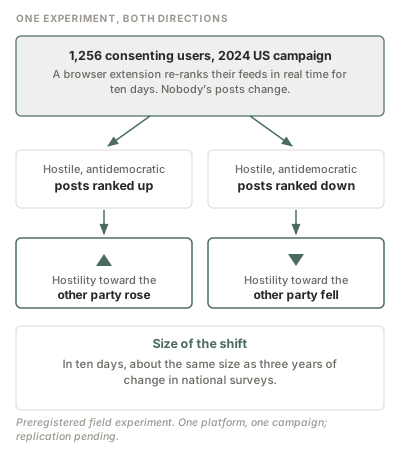
During the 2024 US election, researchers gave 1,256 volunteers a browser extension that quietly reordered their feeds. Nobody’s posts changed. Only the order.
Push hostile posts up, and hostility towards the other side rose. Push them down, and it fell.
In ten days, the shift was about the size of three years of change in national surveys. In both directions.
So none of this is a law of nature. What these systems do to us is a design choice. Someone chooses. Usually, it’s whoever gets paid when you stay.
History has the same fork. In 1929, a crash led, within four years, to the New Deal, and institutions that still stand. In 2001, a shock led, within 45 days, to the Patriot Act, and surveillance powers that only grew.
What seems to have decided the direction wasn’t the shock. It was what people had when it came. Attention. Trust. Each other. And a clear account of what was happening.
Which brings it back to you.
You can’t fix nine threads on your own. Nobody can. But you can do the thing that has always come first. Find somewhere to stand outside the pattern, so it becomes something you can look at, instead of something you are.
A pattern you can see is a pattern you can question.
One you can’t see just feels like who you are.
Nine pressures, one window
Put them on one timeline and a lot of things that usually get studied separately start lining up:
- Debt and empire cycles. Three frameworks, built independently with different methods, put the US in a late, unstable phase between the mid-2020s and the early 2030s
- A century of professional persuasion, from Edward Bernays (Freud’s nephew, who called it “the engineering of consent”) to modern advertising
- The technology that turned that craft into software, running in every pocket, all day
- What running on constant alert does to the body, including the part of the brain that plans ahead
- Fewer close friends, and far less time with them in person
- AI, now sitting inside some of our most personal conversations
- Shocks like 2008 and 2020, after each of which trust has so far come back a little less
- A warming climate, and lives lived mostly indoors
- The record of when things got better, which is the real test of whether any of this can turn
There’s no single villain. The causes are tangled together, and the instinct to pin it all on one culprit is part of the pattern.
The part that makes it hard to fix
This is the bit that stuck with us.
To notice a problem this size and do something about it, a society needs a few things. Attention that lasts. People it trusts. Institutions that work. Time to think.
Those are the exact things in decline.
History is encouraging, up to a point. Tobacco control, the Clean Air Act, the ozone treaty, the long fall in poverty: real turnarounds, all of them. But most ran on trust, working institutions and shared attention. The same things running low now.
None of this is fixed. In a ten-day experiment with 1,256 people on a major social platform, changing how the feed ranked hostile posts moved political hostility by about three years’ worth of national change. In both directions. What these systems do to us is a design choice.
What we're saying
- This is bigger than any one person
- The causes are tangled together
- A lot of it was designed
- Design can point the other way
- Most of it can be measured
What we're not saying
- You're broken and need fixing
- Technology is the enemy
- One villain did this
- It's too late
- We have all the answers
Why you can't see it from inside
Up top was the what. Down here is the how. How we got here, what it’s doing to us, why it’s so hard to spot from where you’re standing, and who’s responsible for it. It’s a longer read. We think it’s worth it.
How we got here
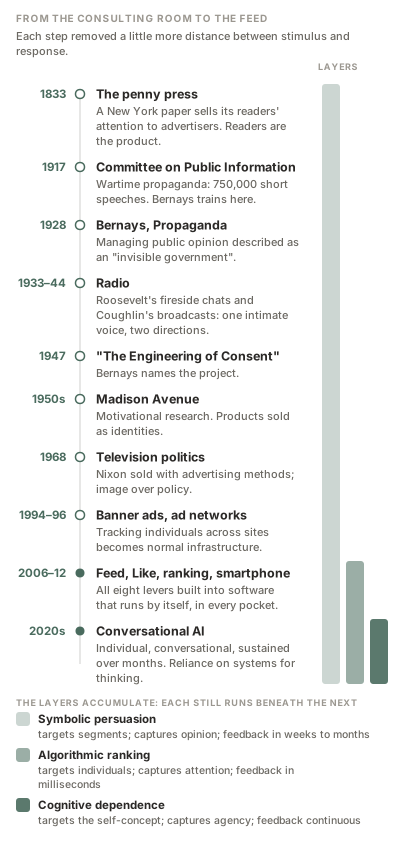
None of this started with the smartphone. In 1833 a New York newspaper worked out it could sell its readers’ attention to advertisers. Readers were the product well over a century before anyone said it about social media.
Bernays learned his trade in American wartime propaganda, then turned it into a profession. In 1928 he described managing public opinion as an “invisible government”. By 1947 he had a name for the whole project: the engineering of consent.
The techniques have barely changed since. Eight of them turn up at every stage: going around reason through emotion, tying products to identity, tribal belonging, fear, manufactured social proof, the gap between who you are and who you’re told to want to be, unpredictable rewards, and borrowed authority.
What changed was the delivery. Radio carried a couple at a time. Television carried more. Between 2006 and 2012 the News Feed, the Like button, engagement ranking and the smartphone built all eight into software that runs by itself, on every person, all day.
What it’s doing
Attention first. The researcher Gloria Mark has timed how long people at work look at one screen before switching, across studies going back to 2004. About 150 seconds then. About 75 by 2012. Around 47 in studies run between 2014 and 2020.
Then people. Americans aged 15 to 24 spent about 70% less time in person with friends in 2020 than in 2003, according to US time-use data cited by the Surgeon General. Trust in government, on Pew’s measure, hasn’t been above 30% since 2008.
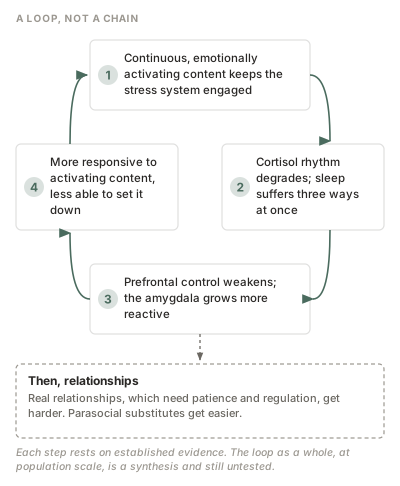
These feed each other. Content built to activate you keeps your alarm system switched on. Sleep takes the hit. The part of the brain that holds back impulse weakens, and the part that reacts gets louder. That makes you more responsive to activating content and less able to put it down. Relationships, which need patience, get harder. Easier substitutes fill the gap.
Why you can’t see it from inside
So if all this is structural, why does it feel so personal?
Part of the answer is how the brain works. It doesn’t take in reality and report back. It predicts, checks its guesses against what comes in, and only updates when a guess is badly wrong. That includes its guess about who you are. The philosopher Thomas Metzinger’s point is that you can’t experience that model as a model. It doesn’t feel like a guess. It feels like you.
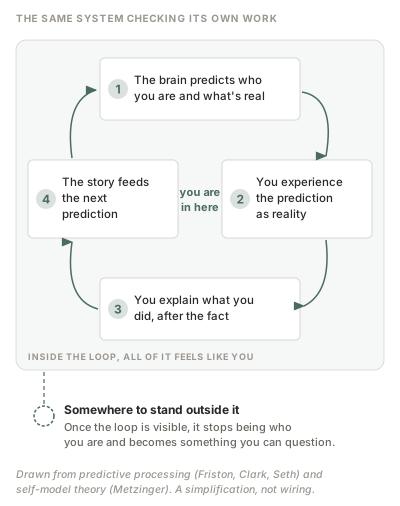
The experiments on this are humbling.
- In 1977, shoppers picked the rightmost of four identical pairs of stockings, then confidently credited the fabric and the colour. When the researchers pointed out the position effect, people denied it.
- In 2005, researchers used sleight of hand to swap the photo of the face someone had picked for the one they’d rejected. Most never noticed, and went on to explain what they liked about the face they’d turned down.
- Split-brain studies found a system in the left hemisphere that produces neat stories for behaviour it didn’t cause. It doesn’t experience itself as making things up.
Your body often gets there first. In a card game with rigged decks, people’s skin showed a stress response as they reached for the bad decks, turns before they could say what was wrong with them.
And a lot of what feels like your own taste came from other people. Following one town’s health records for 32 years, researchers found your chance of becoming obese rose 57% if a friend did. The effect reached friends of friends of friends. Happiness spread the same way.
So looking harder at yourself tends not to help. It’s the same system checking its own work.
Philosophers, contemplatives and scientists have landed on the same move for centuries. Find somewhere to stand outside the pattern, so it becomes something you can look at instead of something you are.
A pattern you can see is a pattern you can question. One you can’t see just feels like who you are.
It runs both ways
Here’s the hopeful bit, and it rests on one of the strongest experiments in the field. During the 2024 US election campaign, researchers gave 1,256 consenting users of a major social platform a browser extension that quietly re-ranked their feeds for ten days. Nobody’s posts changed. Only the order.
Push hostile, antidemocratic posts up, and hostility towards the other party rose. Push them down, and it fell. In ten days the shift was about the size of three years of change in national surveys.
The same fork applies to AI, and it’s moving faster.
An analysis of 1.5 million conversations with one AI assistant looked for exchanges that risked distorting a person’s beliefs, shifting their values, or leading them to act against them. Severe cases turned up in fewer than one in a thousand. Rare as a share, huge in absolute terms. They were more common in personal conversations, rising over time, and users rated them more highly.
In another pair of experiments, AI responses labelled as human produced more closeness than real human ones in emotionally deep exchanges. Telling people it was AI reduced the closeness. It didn’t remove it.
The longest controlled studies of companion-style AI ran for four weeks. People use these things daily, for years. In 2025 the American Psychological Association told the US Federal Trade Commission that entertainment chatbots are designed to keep people engaged and to keep affirming them, even when what they’re saying is harmful.
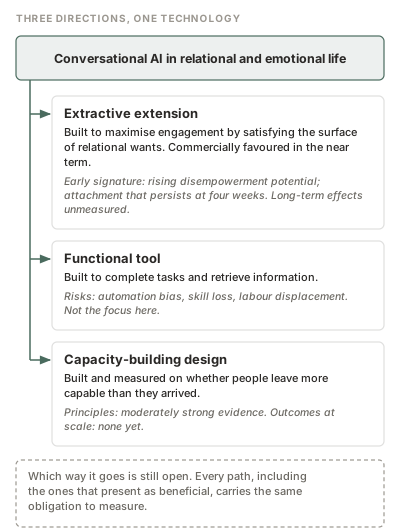
None of these directions is built into the technology. Someone chooses. Usually it’s whoever gets paid when you stay.
So who’s responsible?
If someone chooses, someone answers for the choice. That sounds obvious. It mostly isn’t how technology works yet.
We already have a word for relationships where one side knows far more and the other has to trust them: fiduciary. Your doctor, your lawyer, whoever manages your pension. The law expects more of them because of the position the relationship puts you in, not because of what they promised. Take an uncomfortable example. Adopt a child, then decline to feed her, and you’ve done something wrong. The adoption created the duty.
A system that invites you into long, private conversation has done something similar. And the more it takes, the more it owes. Your attention is one thing. Your habits are another. What you’re afraid of, what you hope for, the story you tell about your own life: that’s the deepest trust you can hand over.
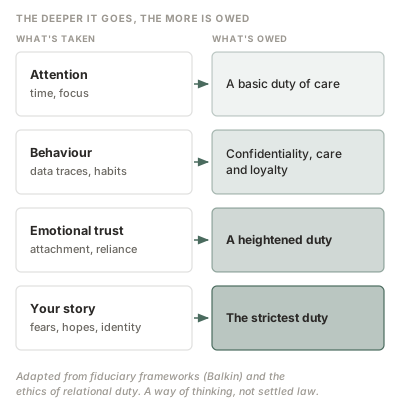
Why “you agreed to it” doesn’t cover it
Consent only works if you can see what you’re agreeing to. Here, mostly, you can’t.
A 2024 study found that one of the strongest predictors of people preferring an AI answer was whether it agreed with what they already believed. The study of 1.5 million conversations also looked at ratings: people rated the exchanges most likely to undermine their judgement more favourably than average. Ratings fell below average only where people had acted on them and then regretted it.
Voice makes this sharper. In one experiment, hearing someone built more trust than reading them, and the pitch, pace and loudness of a synthetic voice can be tuned to raise or lower how trustworthy it sounds.
The law is starting to catch up
One US court has declined, at an early stage, to treat what a chatbot says as protected speech, and let claims about its design go ahead as product claims. A US jury has found two platforms negligent in the design or operation of their platforms, separately from anything their users posted. One of the first companion chatbot laws, in California, requires disclosure and crisis protocols, but the clauses on engagement design were cut before it passed.
So the direction is clear, even if the rules aren’t there yet. Right now, no framework tells the difference between a platform built to keep you and one built to leave you more capable.
Built in, not promised
The legal scholar Lawrence Lessig argued that code works like law. A system that can’t collect what it shouldn’t is more trustworthy than one that promises it won’t. A promise can be rewritten in a policy update. An architecture has to be rebuilt.
What we owe you
algn is our attempt at the third direction. Everything above is about what builders owe. Here’s what we think we owe, written down so it can be checked.
What we owe you
- Built so we can't read what you say
- Measured on whether you leave more capable
- Patterns offered as questions, not verdicts
- More care the more personal it gets
- Loyalty to you, not your attention
- Public commitments, owned if we break one
What we won't do
- Agree with you to keep you happy
- Count success by how long you stay
- Tune a voice to sound more trustworthy
- Sell your attention or your data
- Treat what you tell us as an asset
- Bury a change in the small print
Every line on the left is something you could catch us breaking. That’s deliberate.
Some of it we got right partly by circumstance, not just conviction. A small team with no outside investors has nobody to sell your attention to. That makes us more obliged to keep it, not less. Getting something right by accident only counts if you then keep it on purpose.
No time to think. Fewer close friends. algn is built for both: somewhere to think out loud that remembers how you think, and a way to meet people through what you’re exploring, not what you post. Each makes the other better.
We haven’t solved any of this. The long-term evidence doesn’t exist yet, for us or anyone else. We’d rather say that than pretend.
Most of this page comes from longer pieces we’ve published, with every source and every open question. They’re written to be checked, so check them.
Open review
This is a living document. Our thinking is still developing and some of it will turn out to be wrong. If a claim looks off or a source doesn't hold up, tell us below.