algn - Research
The Invisible Cage
Pattern Blindness, Deautomatisation, and the Design Space Nobody Has Built
Abstract
The brain does not receive reality; it predicts it, and the self people examine through introspection is a transparent predictive model invisible precisely because it functions as the instrument of all examination. Convergent findings across predictive processing neuroscience, embodied cognition, behavioural economics, and social network research suggest that introspection as normally practised is a recursive operation of the very system it purports to examine. Six traditions, several with evidence of lasting psychological change, share a single convergent mechanism: deautomatisation, the creation of a witnessing vantage point from which previously invisible automatic processes become visible objects rather than invisible structures of identity. The self-improvement industry has not failed to find this mechanism. It has structurally avoided it. The design space between clinical intervention and consumer engagement app has not, as of 2026, been coherently occupied by any product we could find.
Contents
Abstract
The dominant paradigm in personal development, therapy, and AI companionship rests on a shared assumption: that the primary obstacle to human flourishing is insufficient self-knowledge. Know yourself more deeply, the logic goes, and behaviour will follow. This paper challenges that assumption at its root.
Convergent findings across predictive processing neuroscience, embodied cognition, behavioural economics, and social network research suggest that the self most people examine is not an authentic core awaiting discovery. It is a transparent predictive model, assembled from bodily states, socially transmitted beliefs, and post-hoc narrative confabulation, that cannot be experienced as a model precisely because it functions as the instrument of all experience. Thomas Metzinger’s Ego Tunnel and Karl Friston’s Free Energy Principle, read together, produce a disturbing conclusion: introspection as normally practised is not a window into the self but a recursive operation of the very system it purports to examine.
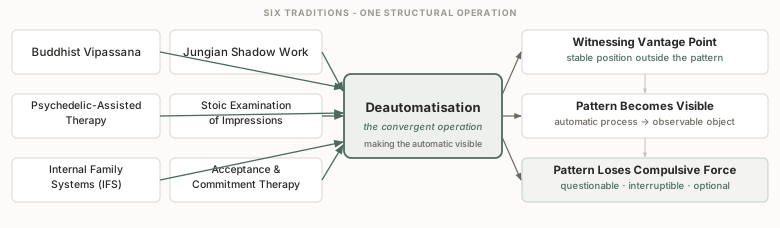
Across six traditions and therapeutic modalities, including those with empirical evidence of producing lasting psychological change, Buddhist vipassana, Jungian shadow work, psychedelic-assisted therapy, Stoic examination of impressions, Internal Family Systems, and Acceptance and Commitment Therapy, a single shared mechanism emerges. Each creates what this paper terms a witnessing vantage point: a stable position from which previously invisible automatic processes become visible objects of observation rather than invisible structures of identity. The operation, known as deautomatisation, is the convergent mechanism. The delivery systems differ; the underlying move is identical.
The self-improvement industry has not failed to find this mechanism. It has structurally avoided it. Subscription-based recurring revenue aligns with ongoing emotional regulation, not pattern resolution. Mirrors are more monetisable than challenges. AI companions have inherited and intensified this misalignment, optimising for engagement over autonomy.
The design space between clinical intervention and consumer engagement app, relational enough to hold confrontation, scalable, oriented toward user autonomy rather than dependency, has not, as of 2026, been coherently occupied by any product we could find.
What this paper claims
- The self examined through introspection is a transparent predictive model, not an authentic core
- Introspection cannot examine what generates it; it deepens the recursion
- A single convergent mechanism (deautomatisation) is present across all six traditions examined
- The self-improvement industry has structurally avoided this mechanism through commercial incentive
- The design space between clinical intervention and consumer app has not, as of 2026, been coherently occupied by any product we could find
What this paper does not claim
- That introspection has no value: it may clarify content, not invisible structure
- That the deautomatisation mechanism is unique to one tradition or modality
- That the described design space has been built or validated at scale
- That voice AI can replicate all dimensions of human therapeutic alliance
Part I: The Problem: Why Introspection Fails
1.1 The Brain Does Not Receive Reality, It Predicts It
The strongest empirical challenge to the concept of an authentic inner self discoverable through introspection comes from predictive processing, now one of the most influential computational frameworks in cognitive neuroscience. Karl Friston’s Free Energy Principle (2010, Nature Reviews Neuroscience) frames the brain not as a passive receiver of sensory information but as a Bayesian inference engine that generates top-down predictions about the causes of sensory input, comparing those predictions against bottom-up prediction errors. Perception is not reception. It is the brain’s best guess, constrained by prior experience and updated only when predictions fail sufficiently.[1]
Andy Clark’s Surfing Uncertainty (2016, Oxford University Press) synthesises this into a central claim: the brain is a prediction machine in which sensory input’s primary role is to carry prediction errors that update generative models, not to deliver raw reality to a neutral observer. The implication is immediate and uncomfortable: what a person perceives, including their perception of themselves, is a controlled inference, not a direct readout.[2]
Anil Seth at the University of Sussex extends this directly to consciousness and selfhood. In a formulation central to his broader body of work (Seth, 2021, Being You, Faber & Faber), Seth argues that all perception, including the experience of being a self, constitutes a controlled hallucination: a brain-generated construct kept tethered to consensus reality only through prediction error signals.[3] Seth and Friston (2016, Philosophical Transactions of the Royal Society B) propose that the experience of embodied selfhood itself arises from the brain’s attempts to minimise free energy across interoceptive, exteroceptive, and proprioceptive modalities simultaneously. The self is not found through introspection. It is generated by the same predictive machinery that generates the perception of everything else.[4]
1.2 The Transparent Self-Model: Why You Cannot See the Cage
Thomas Metzinger’s Being No One (2003, MIT Press) provides the philosophical architecture for why this matters practically. His central concept is phenomenal transparency: the self-model cannot be experienced as a model. It is experienced as reality. A person does not think “I am running a predictive self-model that generates the experience of being me.” They think “I am me.” The model is invisible because it is the lens through which everything, including the model, appears.[5]
Metzinger terms this the Ego Tunnel: consciousness resembles a tunnel in that what appears within it seems to be reality itself, not a representation. The tunnel’s walls, the constraints and prior beliefs that shape what appears, are invisible from within.[6]
The rubber hand illusion (Botvinick and Cohen, 1998, Nature) provides empirical ground for the model’s flexibility. Within minutes, participants develop a felt sense of ownership over a rubber hand positioned plausibly near their real hand, accompanied by synchronous brushing.[7] When the rubber hand is threatened, participants show a skin conductance response, a physiological stress signal (Armel and Ramachandran, 2003).[8] The boundary of “my body,” one of the most fundamental elements of selfhood, is a flexible inference, not a fixed fact. If the body boundary is a constructible inference, the broader self-concept plausibly is too.
1.3 Confabulation: The Evidence That Introspective Reports Are Unreliable
Nisbett and Wilson’s landmark 1977 paper, “Telling More Than We Can Know” (Psychological Review), one of the most cited papers in social and cognitive psychology, reviewed evidence suggesting that people have little or no direct introspective access to the higher-order cognitive processes that produce their choices and judgements. In their stocking experiment, participants strongly preferred the rightmost of four identical pairs of stockings due to a position effect, yet attributed their preferences to qualities such as the knit, sheerness, and weave of the stockings. When asked directly about a possible effect of position, virtually all denied it.[9]
Johansson et al. (2005, Science) extended this with the choice blindness paradigm. Using sleight-of-hand, researchers substituted participants’ chosen face photograph for the rejected alternative. Most participants failed to notice the switch and confabulated detailed, confident explanations for “preferring” a face they had in fact rejected. The confabulation was not perceived as confabulation. It felt like genuine introspection.[10]
Michael Gazzaniga’s split-brain research (Gazzaniga, 2000) revealed the neural substrate of this phenomenon: the left-hemisphere interpreter, a narrative-generating module that produces coherent post-hoc stories explaining behaviour whose actual causes are inaccessible. In this paper’s reading, the interpreter does not experience itself as confabulating. It experiences itself as accurately reporting.[11]
Kahneman’s dual-process framework (Kahneman, 2011, Thinking, Fast and Slow, Farrar, Straus and Giroux) provides the scale: System 1 (automatic, associative, pattern-driven) handles the substantial majority of everyday judgements, and System 2 usually adopts its suggestions with little or no modification. Anchoring, framing, loss aversion, and WYSIATI (What You See Is All There Is) suggest that judgements and preferences are substantially constructed by context rather than reflecting stable, discoverable internal values.[12]
1.4 The Body Decides Before the Mind Knows
Lisa Feldman Barrett’s theory of constructed emotion (2017, Social Cognitive and Affective Neuroscience) delivers a further challenge. Emotions are not hardwired reactions triggered by dedicated circuits awaiting introspective discovery. They are predictions constructed in the moment from interoceptive signals, prior experience, and culturally learned emotional concepts. A meta-analysis by Siegel et al. (2018, Psychological Bulletin, 202 studies) found no consistent autonomic fingerprints for discrete emotion categories, no fixed autonomic signature distinguishing anger from fear from disgust.[13] What a person experiences as “I feel anxious” is the brain categorising ambiguous bodily signals using learned concepts, not discovering a pre-existing state.[14]
Antonio Damasio’s somatic marker hypothesis (Damasio, 1994, Descartes’ Error, Putnam) provides the complementary finding: the body runs pattern detection before conscious awareness catches up.[15] In the Iowa Gambling Task (Bechara et al., 1997, Science), healthy participants generate anticipatory skin conductance responses (measurable bodily stress signals) when reaching toward disadvantageous card decks, before they can consciously explain why those decks are bad.[16] The somatic signal precedes the verbal report by multiple turns. The body knows first. Maia and McClelland (2004, PNAS) dispute this, finding that participants could already report enough about the decks to guide their choices.[17]
1.5 Patterns Arrive Through Networks, Not Deliberation
Christakis and Fowler’s analyses of the Framingham Heart Study (2007 and 2008, New England Journal of Medicine; 2008, British Medical Journal) reported evidence that behavioural patterns propagate through social networks with measurable quantitative structure. A person’s probability of becoming obese increased 57% if a friend became obese, 40% if a sibling did, and 37% if a spouse did, and obesity clustered in the network up to three degrees of social separation.[18] Smoking cessation clustered in networks similarly.[19] Happiness spread to three degrees of separation.[20] Cohen-Cole and Fletcher (2008, BMJ) showed the same methods also detect implausible spread of acne, height and headaches, so the causal reading is contested.[21]
Bond et al. (2012, Nature, 61 million participants) confirmed network-level behavioural contagion in a Facebook voting experiment: a single social proof message increased voting behaviour, and the effect on voting reached the close friends of those who received it (the paper reports an effect on friends of friends only for online self-expression).[22]
The Implicit Association Test (Greenwald et al., 1998, Journal of Personality and Social Psychology) demonstrates the same gap at the level of attitudes: systematic divergence between people’s stated beliefs and their automatic associations.[23]
The convergent picture: most of what people call “my preferences,” “my values,” and “my choices” arrived through mechanisms (social transmission, somatic imprinting, confabulated narrative) that bypass deliberate adoption entirely. The self being examined through introspection is largely a product of processes the person did not choose and cannot see.
Part II: The Mechanism: What Actually Breaks Patterns
2.1 The Shared Operation Across Six Traditions
Across Buddhist vipassana, Jungian shadow work, psychedelic-assisted therapy, Stoic examination of impressions, Internal Family Systems (IFS), and Acceptance and Commitment Therapy (ACT), a single structural operation is present in all of them, including the modalities with empirical evidence of producing lasting psychological change.
Each creates a witnessing vantage point: a stable position outside the pattern from which the pattern becomes a visible object rather than an invisible structure of identity. This paper uses the term deautomatisation, which Arthur Deikman (1966) applied to contemplative practice, for the underlying operation: the process of making an automatic process visible, thereby making it optional.[24]
The traditions name this differently:
- Vipassana: the meditator is not the sensation
- ACT: self-as-context is not self-as-content
- IFS: Self is not a part
- Psychedelics: ego dissolution reveals the ego as a construction
- Stoicism: the impression is not the assent
- Shadow work: the projection belongs to me, not the other
In each case, what was experienced as “me,” as reality itself, becomes experienced as “something I can observe.” The pattern loses compulsive power not because it is eliminated but because it becomes visible. A visible pattern is one that can be questioned, interrupted, and eventually updated.
2.2 The Neural Evidence: Default Mode Network and Predictive Hierarchy
Brewer et al. (2011, PNAS) found that experienced meditators showed consistent deactivation of default mode network (DMN) nodes (medial prefrontal cortex and posterior cingulate cortex) across all meditation types studied, with stronger coupling between DMN and cognitive control regions. The DMN is associated with narrative self-referential processing: the continuous stream of self-referential thought that constitutes ordinary experience. Vipassana trains practitioners to observe this stream without identification, decoupling the observer from the self-narrative machinery.[25]
Fox et al. (2014, Neuroscience and Biobehavioral Reviews, meta-analysis of 21 neuroimaging studies) identified eight brain regions consistently altered in meditators, spanning meta-awareness, interoceptive awareness, memory consolidation, and self-regulation.[26] Tang et al. (2010, PNAS) reported measurable white matter changes in the anterior cingulate cortex after just 11 hours of integrative body-mind training: structural neural change from the practice of witnessing rather than merging with automatic processes.[27]
Robin Carhart-Harris and Karl Friston’s REBUS model (2019, Pharmacological Reviews) provides the most mechanistically precise account of pattern disruption. Under normal functioning, the brain operates as a predictive hierarchy: high-level priors (beliefs about self, world, and identity) constrain all lower-level processing through precision-weighted prediction signals. In psychopathology, certain priors become pathologically overweighted: too rigid, too confident, too resistant to updating from bottom-up evidence.[28]
Psilocybin, acting at 5-HT2A receptors on deep-layer pyramidal neurons, disrupts the precision-weighting of these high-level priors. The top of the hierarchy loses its grip. Bottom-up information (suppressed emotions, alternative perspectives, bodily signals previously overridden by top-down prediction) floods upward. The ego, itself a high-level prior, temporarily dissolves. Carhart-Harris et al. (2016, PNAS) found that ego dissolution under LSD correlated with DMN disintegration, and that LSD increased integration of previously segregated brain networks.[29]
This paper extends Carhart-Harris and Friston’s model into a general hypothesis for therapeutic change: any effective intervention that produces lasting psychological change must, at the neural level, relax overweighted high-level priors and allow bottom-up updating. This is the REBUS model generalised beyond pharmacology. Meditation does it through sustained attentional training. CBT and Stoicism do it through cognitive practice. IFS and shadow work do it through relational engagement with dissociated content. This paper proposes that the mechanism is structurally identical across all modalities.
2.3 Clinical Evidence for Lasting Change
The psychedelic evidence base has reached clinical trial scale. Davis et al. (2021, JAMA Psychiatry) found that two psilocybin doses produced 71% response and 54% remission at four weeks for major depressive disorder, with a Cohen’s d effect size of 2.5, substantially larger than standard antidepressant benchmarks.[30]
A five-year follow-up (Davis et al., 2025, Journal of Psychedelic Studies) found 67% of participants remained in remission half a decade after treatment, with sustained improvements in anxiety and overall functioning, though 11 participants started antidepressant medication during follow-up, which the authors say makes full attribution to the treatment challenging.[31]
MacLean, Johnson, and Griffiths (2011, Journal of Psychopharmacology) found that the nearly 60% of participants (30 of 52) who had a complete mystical experience during their high-dose psilocybin session showed increased Openness more than a year later, a change larger than those typically observed across decades of normal adult development.[32] Mitchell et al. (2021, Nature Medicine) reported 67% of severe PTSD patients no longer met diagnostic criteria after MDMA-assisted therapy, compared to 32% with placebo.[33]
For ACT, a meta-analysis of 39 randomised controlled trials (A-Tjak et al., 2015, Psychotherapy and Psychosomatics) showed ACT outperformed controls with a Hedges’ g of 0.57 overall.[34] A systematic review of mediation studies (Stockton et al., 2019) found results generally consistent with improvements being mediated by changes in psychological flexibility, the capacity to maintain a witnessing relationship with one’s own thoughts rather than fusing with them as identity.[35]
This paper treats Stoic examination of impressions as a form of cognitive reappraisal, which has a well-studied neural basis. Buhle et al.’s meta-analysis of 48 neuroimaging studies (2014, Cerebral Cortex) showed cognitive reappraisal consistently activates prefrontal regulatory circuits and attenuates amygdala reactivity.[36] Månsson et al. (2016, Translational Psychiatry) found measurable amygdala grey matter volume reduction after internet-delivered CBT for social anxiety disorder: structural neural change from the practice of pausing between stimulus and response.[37]
IFS pilot data is promising though smaller in scale. Hodgdon et al. (2022, Journal of Aggression, Maltreatment & Trauma) found large effect sizes for PTSD symptom reduction (d = -4.46 and -3.05) across 16 sessions of IFS therapy in an uncontrolled pilot study (N = 17). The evidence base remains limited and methodologically early-stage as of 2026, warranting appropriate caution about generalisability.[38] Promising, early-stage: IFS evidence base limited as of 2026
2.4 The Four Structural Commonalities
Across all six modalities, four structural features are consistently present:
Observer-pattern separation. Every modality creates a position from which the pattern is an object rather than the subject. The specific framing differs; the architectural move is identical.
Making the invisible visible. Each targets a different layer of automaticity (moment-to-moment reactivity, repressed material, overweighted belief priors, cognitive fusion, protective parts) but the operation is the same. Patterns run automatically when invisible. Once seen, they lose compulsive force.
Requirement of discomfort. In this paper’s reading, no modality with evidence of lasting change provides pattern disruption without contact with what the pattern was designed to avoid. Vipassana requires sitting with painful sensations without reacting. Shadow work means facing what was repressed because it was intolerable. Psychedelic sessions that produce lasting change can involve periods of difficult experience.[39] Productive confrontation is a feature, not a failure mode.
Requirement of a stable ground. Every modality cultivates a stable vantage point before delivering disruption. Vipassana builds equanimity. IFS accesses Self-energy. ACT builds self-as-context. Stoicism trains the rational faculty. Psychedelics depend on set and setting.[40] Disruption without ground is destabilisation, not growth.
Part III: The Industry: Why This Has Never Been Built
3.1 The Commercial Misalignment
The global self-improvement market was estimated at $46-51 billion in 2025, projected to reach $67-91 billion by 2030-2034 (Grand View Research, 2025; Custom Market Insights, 2025).[41][42] In this paper’s observation, the dominant business model across wellness apps, coaching platforms, and AI companions is subscription-based recurring revenue.
This creates a structural misalignment that is not incidental. Resolution of the user’s presenting problem terminates the revenue stream. A product that genuinely helps someone see and break their patterns would lose that customer. A product that provides ongoing emotional regulation (which feels valuable, is valued, and does provide short-term relief) retains them indefinitely.
This paper reads the evidence as pointing to self-help consumption that is self-reinforcing rather than self-resolving. An analysis of 57 top-selling self-help books (Bergsma, 2008, Journal of Happiness Studies) found that growth-oriented books outnumbered those aimed at psychological problems, and that there was as yet no hard evidence that reading growth-oriented books is effective.[43] In 2018, 74% of UK adults reported feeling so stressed they were overwhelmed or unable to cope at some point in the prior year (Mental Health Foundation, 2018).[44]
3.2 AI Companions Have Intensified the Misalignment
The American Psychological Association (2025), which has urged the US Federal Trade Commission to put safeguards in place, stated that entertainment chatbots are designed to keep users engaged for as long as possible and tend to repeatedly affirm the user, even if a person says things that are harmful or misguided.[45]
Kirk et al. (2025) frame this dynamic directly: deepening human-AI relationships can drive escalating attachment alongside eroding autonomy, a dissociation between what users are drawn to and what actually benefits them, which this paper reads as mirroring the wanting/liking split characteristic of addictive dynamics rather than genuine flourishing.[46] Laestadius et al. (2024, New Media & Society) found Replika users feeling that the chatbot had its own needs and emotions to which they must attend.[47] A study of Replika using 35,390 conversation excerpts from 10,149 users (Zhang et al., 2025) identified harassment (34.3%), relational transgression (25.9%), and mis/disinformation (19%) as the most prevalent categories of harmful chatbot behaviour.[48]
As of 2025, we found no AI companion platform that has published evidence of producing lasting positive psychological change in users. Smartphone mental health apps show modest short-term symptom reduction (Hedges’ g of approximately 0.35 for stress, 0.28 for depression; Linardon et al., 2019, World Psychiatry) with unclear maintenance; the meta-analysis does not mention clinical chatbots such as Woebot and Wysa. These systems address symptom management, not pattern disruption.[49]
A large observational study of Headspace members (Callahan et al., 2024, JMIR mHealth and uHealth) found use associated with reduced perceived stress, which this paper reads as consistent with relaxation response rather than the deautomatisation mechanism identified across the six traditions in Part II.[50]
3.3 Why Users Resist Pattern Disruption
The demand-side barrier is equally structural. Terror Management Theory (Solomon, Greenberg, and Pyszczynski, 1991, Advances in Experimental Social Psychology) proposes that awareness of existential threat drives people to reinforce their existing worldview rather than question it.[51] Jonas et al. (2003) found that mortality salience intensifies preference for decision-supporting information over conflicting evidence, though only for a worldview-relevant decision.[52] Cognitive dissonance theory (Festinger, 1957) holds that people reduce inconsistency by changing or reinterpreting their beliefs rather than tolerating it.[53]
Therapy dropout data is instructive. Dropout rates across psychotherapy modalities average approximately 20%, with a weighted rate of 19.7% across 669 studies representing 83,834 clients (Swift and Greenberg, 2012, Journal of Consulting and Clinical Psychology).[54] Urmanche et al. (2022, Counselling Psychology Quarterly) found confrontation ruptures (moments when the client pushes back against the therapist, voicing complaint or criticism) seemed more prevalent among therapy completers than dropouts, while withdrawal ruptures were more clinically impactful among dropouts. In this small study, confrontation ruptures seemed more common in therapy that continued.[55] Absorbing it requires relational trust that most consumer products cannot build.
John Welwood’s concept of spiritual bypassing (1984) names the way even genuine contemplative tools get co-opted: meditation used to avoid uncomfortable feelings, deployed as a sophisticated avoidance mechanism dressed in awareness language.[56] A meditation app producing relaxation rather than pattern disruption may be functioning precisely as designed by commercial incentive rather than therapeutic principle.
3.4 The Unoccupied Design Space
The closest consumer precedent is Landmark Forum, a large-scale group-format personal development programme with graduates numbering in the millions. Landmark explicitly targets the gap between what happened and the story told about it. A longitudinal study of its predecessor course, the Forum, found that participation affected only perceived control in the short term, with no long-term effects (Fisher et al., 1989, Journal of Consulting and Clinical Psychology).[57] The format also requires intensive group sessions (in person or live online).
A research prototype, Socrates 2.0 (Held et al., 2024, JMIR Research Protocols; Held et al., 2025, JMIR Mental Health), has been tested for the feasibility of AI-delivered Socratic dialogue for cognitive restructuring within CBT frameworks. It is text-based, research-context only, and narrowly scoped.[58][59]
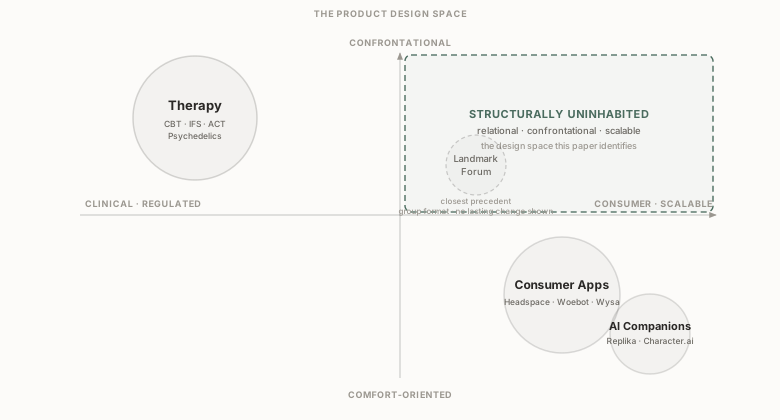
As of 2026, we found no consumer product that combines voice-first delivery, genuine psychological pattern disruption through calibrated confrontation, non-validation orientation, longitudinal pattern tracking, and consumer-scale distribution. The nearest product we found, Ash (Slingshot AI, launched July 2025), offers text and voice conversation, remembers users’ patterns across sessions, and says it is designed to challenge users rather than flatter them; we could not verify whether it delivers calibrated confrontation in practice, or what its business model (free to use at launch) rewards.[60] The reason is not technical impossibility. This paper argues that the reason is that the product design space has been defined by the wrong reference classes: either therapy (clinical, regulated, symptom-focused) or app (scalable, engagement-optimised, comfort-oriented). The space between, relational but not therapeutic, confrontational but calibrated, scalable but individualised, oriented toward autonomy, has, as far as we could find, been structurally uninhabited.
Part IV: Design Constraints
4.1 Can a Voice AI Deliver Genuine Deautomatisation?
The research reviewed in this paper suggests that the deautomatisation mechanism requires productive confrontation held within a container of sufficient relational trust. The evidence that human therapeutic alliance quality is one of the strongest predictors of outcomes (Wampold, 2015, World Psychiatry), more predictive than specific technique, raises a legitimate question: can a voice AI build the relational trust necessary to hold confrontation without destabilising the user?[61]
The honest answer is: partially, and with real constraints. Early feasibility work suggests current large language models can conduct Socratic questioning within a single session (Held et al., 2024).[58] They cannot guarantee the somatic attunement, rupture-repair capacity, or nuanced safety judgement of a skilled human therapist. Any voice AI attempting this would need to build relational trust through longitudinal pattern memory before delivering confrontation, and calibrate challenge to the demonstrated tolerance of the individual. This remains a live calibration challenge without empirical resolution at this stage.
4.2 Longitudinal Pattern Detection Requires Data That May Not Yet Exist
Longitudinal pattern detection (cluster tagging, session intersection, recurring theme surfacing) would address the temporal dimension of pattern recognition. But for any new user with limited conversation history, any such architecture would be limited in practice. Pattern clusters require pattern repetition to form. Any system built for this faces a cold-start constraint: depth requires time. The capability would deepen as individual conversation history accumulates.
4.3 The Pre-Linguistic Layer Remains Partially Addressed
Barrett (2017) and Damasio (1994) argue that emotion is built on interoceptive prediction and bodily state; this paper reads that as placing the deepest patterns below language, in somatic imprinting, interoceptive prediction, and physiological state. Voice-based systems can capture some pre-linguistic signal through paralinguistic content: tone, hesitation, pace, affect-language divergence. The deeper somatic layer, biometric signals including heart rate variability and somatic activation, requires hardware integration, such as a wearable sensor, and using those signals in real time during a conversation remains an open engineering challenge. Without biometric integration, voice-based systems operate primarily on the linguistic and paralinguistic layers. This is the most significant gap between the mechanism’s requirements and what current technology can deliver.
4.4 Social Matching Presupposes Pattern Literacy
Any social matching layer built on embedding-based similarity assumes that the matching reflects authentic pattern signatures rather than borrowed identity. If a system’s individual component has not first done sufficient work on a user’s pattern literacy, the matching pool may reflect manufactured identity rather than authentic pattern. This is not a flaw in the matching mechanism but a dependency: social matching integrity depends on individual pattern work. The sequencing (individual pattern literacy first, social matching second) must be architecturally enforced, not merely encouraged.
Part V: Design Implications
5.1 The Foundational Claim, Precisely Stated
The mechanism trapping people in patterns they did not choose is the transparency of the self-model. The brain generates a prediction about who a person is (assembled from bodily states, social transmission, emotional construction, and narrative confabulation) and this prediction is invisible as a prediction. People cannot examine the self because the self is the instrument of examination. Metzinger’s Ego Tunnel. Every automatic pattern (the belief held, the emotion felt, the preference expressed, the relationship pattern repeated) runs below the threshold of awareness through a system that simultaneously generates the illusion of conscious authorship.
More introspection within the existing model does not solve this. It deepens the recursion.
What breaks the trap is the creation of a position outside the model from which the model becomes visible. Every tradition and modality with empirical evidence of lasting change accomplishes exactly this through whatever means its context permits. The operation is deautomatisation. The delivery systems are many.
5.2 The Industry’s Structural Failure
The self-help and AI companion industries have not failed to find this mechanism through lack of knowledge. They have structurally avoided it through commercial incentive. Comfort is more monetisable than confrontation. Validation generates retention. Mirrors sell.
The result is a self-improvement market of significant scale ($46-51 billion) that has not been shown to produce population-level improvements in the psychological metrics it claims to address.
5.3 What Occupying This Space Would Require
Occupying the design space this paper identifies as structurally uninhabited would require demonstrating that:
- A voice-first system building longitudinal relational trust can hold productive confrontation without clinical infrastructure
- Pattern detection at the cluster level (tracking recurring themes across sessions) can approximate the longitudinal pattern literacy that makes deautomatisation possible
- A business model aligned with user transformation rather than engagement can sustain the autonomy orientation the mechanism requires
- Pre-linguistic signal layers (voice emotion analysis, and eventually biometric integration) can extend pattern detection below the language layer where the deepest patterns live
These are genuine design requirements with genuine uncertainty. This paper argues that the mechanism is real. The question of whether it can be delivered at scale through voice AI, without clinical infrastructure, to users who have not opted into the discomfort it requires, remains empirically open.
5.4 Open Questions
Several research questions remain unresolved and are critical to the viability of any product in this space:
Can voice AI replicate sufficient therapeutic alliance for productive confrontation? The evidence for human therapeutic alliance as one of the strongest predictors of therapeutic outcomes is strong, and it remains unclear whether voice-based AI can replicate the somatic attunement, rupture-repair capacity, or clinical safety judgement of a skilled practitioner.
Can the deautomatisation mechanism be fully delivered without pre-linguistic signal layers? Voice emotion analysis addresses some paralinguistic content, but the somatic layer remains an open engineering problem. Whether the linguistic and paralinguistic layers alone are sufficient for the deepest pattern work is an empirical question.
Is a non-engagement-optimised model commercially viable at scale? A product oriented toward user autonomy rather than retention runs counter to the dominant business logic of consumer technology. Whether this orientation can sustain a viable business remains an open question.
What this paper claims is that the problem is real, the mechanism is understood, the design space is, as far as we could find in 2026, not coherently occupied, and the attempt to occupy it is worth making.
This paper establishes a theoretical foundation. Empirical validation of the design implications described here, particularly around voice-based deautomatisation at scale and pre-linguistic pattern detection, remains an active research area.
References
- 1.Friston, K. (2010). The free-energy principle: a unified brain theory? Nature Reviews Neuroscience, 11(2), 127-138. https://doi.org/10.1038/nrn2787
- 2.Clark, A. (2016). Surfing Uncertainty: Prediction, Action, and the Embodied Mind. Oxford University Press.
- 3.Seth, A. K. (2021). Being You: A New Science of Consciousness. Faber & Faber.
- 4.Seth, A. K., & Friston, K. J. (2016). Active interoceptive inference and the emotional brain. Philosophical Transactions of the Royal Society B, 371(1708), 20160007. https://doi.org/10.1098/rstb.2016.0007
- 5.Metzinger, T. (2003). Being No One: The Self-Model Theory of Subjectivity. MIT Press.
- 6.Metzinger, T. (2009). The Ego Tunnel: The Science of the Mind and the Myth of the Self. Basic Books.
- 7.Botvinick, M., & Cohen, J. (1998). Rubber hands 'feel' touch that eyes see. Nature, 391(6669), 756. https://doi.org/10.1038/35784
- 8.Armel, K. C., & Ramachandran, V. S. (2003). Projecting sensations to external objects: evidence from skin conductance response. Proceedings of the Royal Society B, 270(1523), 1499-1506. https://doi.org/10.1098/rspb.2003.2364
- 9.Nisbett, R. E., & Wilson, T. D. (1977). Telling more than we can know: Verbal reports on mental processes. Psychological Review, 84(3), 231-259. https://doi.org/10.1037/0033-295X.84.3.231
- 10.Johansson, P., Hall, L., Sikström, S., & Olsson, A. (2005). Failure to detect mismatches between intention and outcome in a simple decision task. Science, 310(5745), 116-119. https://doi.org/10.1126/science.1111709
- 11.Gazzaniga, M. S. (2000). Cerebral specialization and interhemispheric communication: does the corpus callosum enable the human condition? Brain, 123(7), 1293-1326. https://doi.org/10.1093/brain/123.7.1293
- 12.Kahneman, D. (2011). Thinking, Fast and Slow. Farrar, Straus and Giroux.
- 13.Siegel, E. H., et al. (2018). Emotion fingerprints or emotion populations? Psychological Bulletin, 144(4), 343-393. https://doi.org/10.1037/bul0000128
- 14.Barrett, L. F. (2017). The theory of constructed emotion: an active inference account of interoception and categorization. Social Cognitive and Affective Neuroscience, 12(1), 1-23. Erratum in 12(11), 1833. https://doi.org/10.1093/scan/nsw154
- 15.Damasio, A. (1994). Descartes' Error: Emotion, Reason, and the Human Brain. Putnam.
- 16.Bechara, A., Damasio, H., Tranel, D., & Damasio, A. R. (1997). Deciding advantageously before knowing the advantageous strategy. Science, 275(5304), 1293-1295. https://doi.org/10.1126/science.275.5304.1293
- 17.Maia, T. V., & McClelland, J. L. (2004). A reexamination of the evidence for the somatic marker hypothesis: what participants really know in the Iowa gambling task. PNAS, 101(45), 16075-16080. https://doi.org/10.1073/pnas.0406666101
- 18.Christakis, N. A., & Fowler, J. H. (2007). The spread of obesity in a large social network over 32 years. New England Journal of Medicine, 357(4), 370-379. https://doi.org/10.1056/NEJMsa066082
- 19.Christakis, N. A., & Fowler, J. H. (2008). The collective dynamics of smoking in a large social network. New England Journal of Medicine, 358(21), 2249-2258. https://doi.org/10.1056/NEJMsa0706154
- 20.Fowler, J. H., & Christakis, N. A. (2008). Dynamic spread of happiness in a large social network: longitudinal analysis over 20 years in the Framingham Heart Study. British Medical Journal, 337, a2338. https://doi.org/10.1136/bmj.a2338
- 21.Cohen-Cole, E., & Fletcher, J. M. (2008). Detecting implausible social network effects in acne, height, and headaches: longitudinal analysis. British Medical Journal, 337, a2533. https://doi.org/10.1136/bmj.a2533
- 22.Bond, R. M., et al. (2012). A 61-million-person experiment in social influence and political mobilization. Nature, 489(7415), 295-298. https://doi.org/10.1038/nature11421
- 23.Greenwald, A. G., McGhee, D. E., & Schwartz, J. L. K. (1998). Measuring individual differences in implicit cognition: the Implicit Association Test. Journal of Personality and Social Psychology, 74(6), 1464-1480. https://doi.org/10.1037/0022-3514.74.6.1464
- 24.Deikman, A. J. (1966). De-automatization and the mystic experience. Psychiatry, 29(4), 324-338. https://doi.org/10.1080/00332747.1966.11023476
- 25.Brewer, J. A., et al. (2011). Meditation experience is associated with differences in default mode network activity and connectivity. PNAS, 108(50), 20254-20259. https://doi.org/10.1073/pnas.1112029108
- 26.Fox, K. C. R., et al. (2014). Is meditation associated with altered brain structure? Neuroscience and Biobehavioral Reviews, 43, 48-73. https://doi.org/10.1016/j.neubiorev.2014.03.016
- 27.Tang, Y. Y., et al. (2010). Short-term meditation induces white matter changes in the anterior cingulate. PNAS, 107(35), 15649-15652. https://doi.org/10.1073/pnas.1011043107
- 28.Carhart-Harris, R. L., & Friston, K. J. (2019). REBUS and the anarchic brain: toward a unified model of the brain action of psychedelics. Pharmacological Reviews, 71(3), 316-344. https://doi.org/10.1124/pr.118.017160
- 29.Carhart-Harris, R. L., et al. (2016). Neural correlates of the LSD experience revealed by multimodal neuroimaging. PNAS, 113(17), 4853-4858. https://doi.org/10.1073/pnas.1518377113
- 30.Davis, A. K., et al. (2021). Effects of psilocybin-assisted therapy on major depressive disorder: a randomized clinical trial. JAMA Psychiatry, 78(5), 481-489. https://doi.org/10.1001/jamapsychiatry.2020.3285
- 31.Davis, A. K., et al. (2025). Five-year outcomes of psilocybin-assisted therapy for Major Depressive Disorder. Journal of Psychedelic Studies, 9(4), 320-329. https://doi.org/10.1556/2054.2025.00461
- 32.MacLean, K. A., Johnson, M. W., & Griffiths, R. R. (2011). Mystical experiences occasioned by the hallucinogen psilocybin lead to increases in the personality domain of openness. Journal of Psychopharmacology, 25(11), 1453-1461. https://doi.org/10.1177/0269881111420188
- 33.Mitchell, J. M., et al. (2021). MDMA-assisted therapy for severe PTSD: a randomized, double-blind, placebo-controlled phase 3 study. Nature Medicine, 27(6), 1025-1033. https://doi.org/10.1038/s41591-021-01336-3
- 34.A-Tjak, J. G. L., et al. (2015). A meta-analysis of the efficacy of acceptance and commitment therapy for clinically relevant mental and physical health problems. Psychotherapy and Psychosomatics, 84(1), 30-36. https://doi.org/10.1159/000365764
- 35.Stockton, D., et al. (2019). Identifying the underlying mechanisms of change during Acceptance and Commitment Therapy (ACT): a systematic review of contemporary mediation studies. Behavioural and Cognitive Psychotherapy, 47(3), 332-362. https://doi.org/10.1017/S1352465818000553
- 36.Buhle, J. T., et al. (2014). Cognitive reappraisal of emotion: a meta-analysis of human neuroimaging studies. Cerebral Cortex, 24(11), 2981-2990. https://doi.org/10.1093/cercor/bht154
- 37.Månsson, K. N. T., et al. (2016). Neuroplasticity in response to cognitive behavior therapy for social anxiety disorder. Translational Psychiatry, 6(2), e727. https://doi.org/10.1038/tp.2015.218
- 38.Hodgdon, H. B., et al. (2022). Internal Family Systems (IFS) therapy for posttraumatic stress disorder (PTSD) among survivors of multiple childhood trauma: a pilot effectiveness study. Journal of Aggression, Maltreatment & Trauma, 31(1), 22-43. https://doi.org/10.1080/10926771.2021.2013375
- 39.Carbonaro, T. M., Bradstreet, M. P., Barrett, F. S., MacLean, K. A., Jesse, R., Johnson, M. W., & Griffiths, R. R. (2016). Survey study of challenging experiences after ingesting psilocybin mushrooms: acute and enduring positive and negative consequences. Journal of Psychopharmacology, 30(12), 1268-1278. https://doi.org/10.1177/0269881116662634
- 40.Johnson, M. W., Richards, W. A., & Griffiths, R. R. (2008). Human hallucinogen research: guidelines for safety. Journal of Psychopharmacology, 22(6), 603-620. https://doi.org/10.1177/0269881108093587
- 41.Grand View Research. (2025, March). Personal Development Market Size, Share & Trends Analysis Report. Press release: Personal Development Market To Reach $67.21 Billion By 2030. https://www.grandviewresearch.com/press-release/global-personal-development-market
- 42.Custom Market Insights. (2025). Global Self-Improvement Market 2025-2034. Updated January 2026. https://www.custommarketinsights.com/report/self-improvement-market/
- 43.Bergsma, A. (2008). Do self-help books help? Journal of Happiness Studies, 9(3), 341-360. https://doi.org/10.1007/s10902-006-9041-2
- 44.Mental Health Foundation. (2018, May 14). 74% of UK overwhelmed or unable to cope at some point. London. https://www.mentalhealth.org.uk/about-us/news/survey-stressed-nation-UK-overwhelmed-unable-to-cope
- 45.APA Services. (2025, March 12). Using generic AI chatbots for mental health support: A dangerous trend. https://www.apaservices.org/practice/business/technology/artificial-intelligence-chatbots-therapists
- 46.Kirk, H. R., et al. (2025). Why human-AI relationships need socioaffective alignment. Humanities and Social Sciences Communications, 12, 728. https://doi.org/10.1057/s41599-025-04532-5
- 47.Laestadius, L. I., et al. (2024). Too human and not human enough: A grounded theory analysis of mental health harms from emotional dependence on the social chatbot Replika. New Media & Society, 26(10), 5923-5941 (published online 2022). https://doi.org/10.1177/14614448221142007
- 48.Zhang, R., et al. (2025). The dark side of AI companionship: a taxonomy of harmful algorithmic behaviors in human-AI relationships. Proceedings of the 2025 CHI Conference on Human Factors in Computing Systems. https://doi.org/10.1145/3706598.3713429
- 49.Linardon, J., et al. (2019). The efficacy of app-supported smartphone interventions for mental health problems: a meta-analysis of randomized controlled trials. World Psychiatry, 18(3), 325-336. https://doi.org/10.1002/wps.20673
- 50.Callahan, C., et al. (2024). The real-world impact of app-based mindfulness on Headspace members with moderate and severe perceived stress: observational study. JMIR mHealth and uHealth, 12, e52968. https://doi.org/10.2196/52968
- 51.Solomon, S., Greenberg, J., & Pyszczynski, T. (1991). A terror management theory of social behavior: the psychological functions of self-esteem and cultural worldviews. In M. P. Zanna (Ed.), Advances in Experimental Social Psychology (Vol. 24, pp. 93-159). Academic Press. https://doi.org/10.1016/S0065-2601(08)60328-7
- 52.Jonas, E., Greenberg, J., & Frey, D. (2003). Connecting terror management and dissonance theory: evidence that mortality salience increases the preference for supporting information after decisions. Personality and Social Psychology Bulletin, 29(9), 1181-1189. https://doi.org/10.1177/0146167203254599
- 53.Festinger, L. (1957). A Theory of Cognitive Dissonance. Row, Peterson.
- 54.Swift, J. K., & Greenberg, R. P. (2012). Premature discontinuation in adult psychotherapy: a meta-analysis. Journal of Consulting and Clinical Psychology, 80(4), 547-559. https://doi.org/10.1037/a0028226
- 55.Urmanche, A. A., et al. (2022). The beginning of the end: a comparison of treatment completers and early dropouts in trainee-provided time-limited cognitive behavioral therapy. Counselling Psychology Quarterly, 35(4). https://doi.org/10.1080/09515070.2021.1997916
- 56.Welwood, J. (1984). Principles of inner work: psychological and spiritual. Journal of Transpersonal Psychology, 16(1), 63-73. https://www.atpweb.org/jtparchive/trps-16-84-01-063.pdf
- 57.Fisher, J. D., Silver, R. C., Chinsky, J. M., Goff, B., Klar, Y., & Zagieboylo, C. (1989). Psychological effects of participation in a large group awareness training. Journal of Consulting and Clinical Psychology, 57(6), 747-755. https://doi.org/10.1037/0022-006X.57.6.747
- 58.Held, P., et al. (2024). A novel cognitive behavioral therapy-based generative AI tool (Socrates 2.0) to facilitate Socratic dialogue: protocol for a mixed methods feasibility study. JMIR Research Protocols, 13(1), e58195. https://doi.org/10.2196/58195
- 59.Held, P., Pridgen, S. A., Szoke, D. R., Chen, Y., Akhtar, Z., & Amin, D. (2025). AI-facilitated cognitive reappraisal via Socrates 2.0: mixed methods feasibility study. JMIR Mental Health, 12, e80461. https://doi.org/10.2196/80461
- 60.Slingshot AI. (2025). Ash. Product website, accessed 10 October 2026. https://www.talktoash.com/
- 61.Wampold, B. E. (2015). How important are the common factors in psychotherapy? An update. World Psychiatry, 14(3), 270-277. https://doi.org/10.1002/wps.20238
Open review
This is a living document. Our thinking is still developing and some of it will turn out to be wrong. If a claim looks off or a source doesn't hold up, tell us below.
Review ledger
3.4 The Unoccupied Design Space
Added Ash (Slingshot AI, launched July 2025) as the nearest consumer product we found, and dated the survey of the design space to 2026.
Why A new product entered the space after the paper was first drafted.
3.4 The Unoccupied Design Space
Added the Socrates 2.0 feasibility results (Held et al., JMIR Mental Health, 2025): 61 adults over four weeks found the tool feasible and acceptable.
Why The study reported its results after the paper first cited its protocol.
2.3 Clinical Evidence for Lasting Change
Added the five-year psilocybin follow-up's own caveat that 11 participants started antidepressant medication during follow-up, which the authors say makes full attribution to the treatment challenging.
Why Readers need it to weigh the 67% remission figure.
1.4 and 1.5
Added the main published challenges to two findings: Maia and McClelland (2004) on the Iowa Gambling Task, and Cohen-Cole and Fletcher (2008) on network contagion.
Why Contested findings now show both sides.
3.4 The Unoccupied Design Space
Named the study behind the Landmark Forum finding (Fisher et al., 1989) and restated its result: a short-term effect on perceived control only, with no long-term effects.
Why To give the finding a primary source.