Technical
Privacy Architecture
Your memory belongs to you, architecturally, not contractually.
You’ll tell Sera things you haven’t said out loud to anyone. That deserves more than a privacy policy. A policy is a promise, and promises can be rewritten. So we built the protection into the structure of algn itself, in layers.
Your memory lives on your device, not on our servers, encrypted with a key that never leaves it. When your words travel to be answered, they leave as algn, never as you, and the servers that answer them keep nothing. Before anything is used to find people you might want to meet, the most personal parts of your life are stripped out and what’s left is scrambled with a secret key. And nothing about you reaches another person unless you choose to send it.
No single layer carries the weight alone. Each one is built as if the one outside it might fail.

Your memory is yours. Not licensed to us, not held on your behalf, not a product waiting to be sold. Yours, on your device, under your key.
Your voice is streamed, never stored. It’s turned into words as you speak, by servers that keep nothing, and Sera’s voice streams back the same way. It isn’t recorded, by us or by any server it passes through.
Your conversations stay yours. Your history lives in your vault. Each turn passes through our servers only while it’s being answered, with nothing attached that says who you are, and then it’s gone.
Matching happens in layers. Before anything leaves your device for Us, algn’s social platform, sensitive parts of your life like health, sexuality and trauma are stripped out. You see and approve the exact keywords that would leave. What’s left becomes numbers on your device, and those numbers are scrambled with a secret key. Even after a match, nothing about you reaches anyone unless you send it, and they choose whether to accept. Then you stay masked, with no name and no photo, until you’ve built something real and both choose to unmask.





What never reaches us, we can't sell.
Owning your memory means really owning it. It lives on your device and in a backup only your passphrase opens. We can’t restore it for you, and that’s the point: we never had it.
What algn does
- Keeps your memory on your device, encrypted
- Sends your words as algn, never as you
- Strips sensitive topics before any matching
- Scrambles matching data with a secret key
- Shares nothing about you unless you choose
- Keeps you masked until you both unmask
- Lets you see and delete what it holds
What it doesn't
- Record or store your voice
- Keep your conversations on its servers
- Train models on what you say
- Sell, share or broker your data
- Match you on health or sensitive topics
- Show your name or photo without your say
- Ask you to take its word for it
Where your data lives
Here is the whole architecture, one layer at a time. We name the standards we use. We keep the exact configuration to ourselves, because publishing it would only help someone trying to get around it.
Start with the simplest question: where is your data at any moment? There are only three answers.
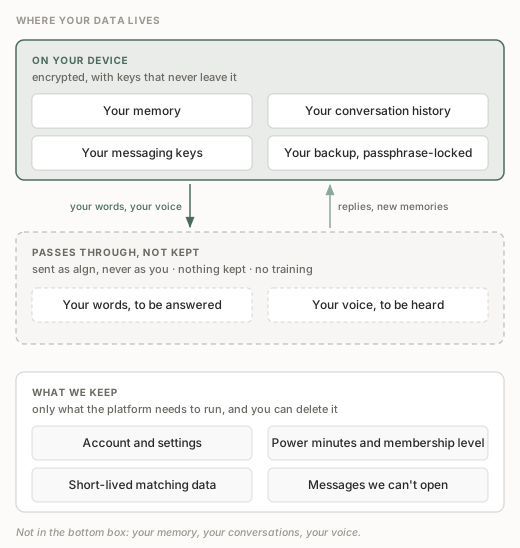
Layers 1 and 2 · On your device, encrypted
Everything Sera remembers about you lives in a vault on your own device. algn is a web app you can install on your phone or computer, and the vault sits in that device’s browser storage: who matters to you, the patterns Sera has noticed, and every conversation thread. None of it is kept on our servers.
The vault is encrypted at rest with AES-256-GCM, using the browser’s built-in Web Crypto. The key is created on your device, can’t be exported, and never leaves it. algn never holds it. There’s no home-made cryptography anywhere in this, only the standard primitives your browser already ships and that security researchers test every day.
Inside, memory is kept in two layers. Who you are is held separately from what’s happening in your life right now. Situational memory fades and retires over time, and similar memories merge rather than pile up, so the vault holds what’s useful and lets go of the rest. You can open it and see every memory Sera holds, edit or delete any of them, and see how they connect as a map of your patterns.
Your backup. Instead of a copy on our servers, you get a .algn file, locked with a passphrase only you know. The key is derived from that passphrase on your device (PBKDF2 with SHA-256) and the contents are sealed with AES-256-GCM.
- On a computer: the backup is a linked file that updates itself. After every write it’s read back and checked.
- On a phone: you export it when you choose, to your files or your own cloud storage, through the share sheet.
- On a new device: the file and your passphrase are all you need to restore. Nothing comes from us.
The file’s header holds only what’s needed to decrypt it. No user ID, no counts of what’s inside. Every time it’s opened it’s checked for integrity, and a file that’s been tampered with or damaged is rejected. In the app you can inspect it yourself: the raw header, its size, its fingerprint and the ciphertext.
Deleting is just as direct. Clear the vault and it’s gone from your device. Matching data can be deleted from our servers whenever you ask, and deleting your account removes everything we hold about you.
LAYERS 1 AND 2 · VAULT AND BACKUP · Vault: on-device browser storage, AES-256-GCM (Web Crypto) · Vault key: generated on device, non-extractable, never sent · Backup: .algn file, passphrase-derived key (PBKDF2-SHA-256), AES-256-GCM · File header: decryption parameters only, no user ID, no counts · Integrity checked on every open, tampered files rejected · Standard browser cryptography only
The safest data is the data we never receive.
Layer 3 · Anonymised
Sera’s replies are written by powerful models running on specialist servers. Your device never talks to them directly. Every request goes to our servers first, and leaves from there as algn.
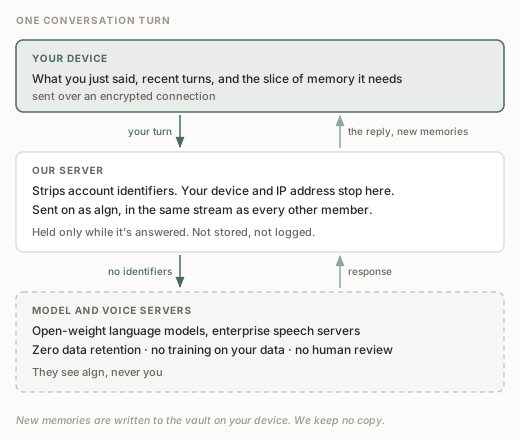
- No account identifiers: nothing that ties a request to your account, your name or your email travels with it.
- No device, no IP address: the model servers see our servers, never your phone or computer, so they never learn where you are.
- One stream: your requests go out in the same stream as every other member’s, all from algn. There’s no per-person trail for anyone to follow.
- Our own limits: we manage usage limits ourselves, so the model servers never need to know who’s asking or how often.
- Only what’s needed: each request carries the turn, the recent conversation and the slice of memory it needs. Never your whole vault.
The same holds for everything that runs in the background.
Layer 4 · Nothing kept
Anonymising a request is one layer. Making sure nothing survives it is the next.
- Transient: each request is held only while it’s being answered, then dropped. It isn’t stored, and it isn’t logged.
- Zero data retention: every server that handles your words or your voice works under zero data retention. None of them train on your data, and none of them allow human review of it.
- Open-weight language models: every model that writes Sera’s replies or reasons in the background is open-weight.
- Enterprise-grade speech: transcription and Sera’s voice run on enterprise speech servers under the same zero-retention terms. No consumer AI apps anywhere in the stack.
Alongside each reply, background processes run in parallel: one reads tone and pacing, one draws out what’s worth remembering, one reasons about patterns across conversations. They follow exactly the same rules, and none of them slows the reply. When a new memory is drawn out, it’s sent back to your device and written into your vault. We keep no copy.
A safety check runs as part of that pattern reasoning, so Sera can respond with care when a conversation turns hard. No person watches your conversations, and there’s no central record of difficult moments.
Your stored memory and your history live only on your device, out of our reach. The words of a turn pass through our servers only while it’s being answered, with nothing tying them to your account, and then they’re gone.
Your voice
Voice gets the same layers. Your speech is streamed to transcription servers as you talk and turned into words in real time, and Sera’s voice streams back from voice-synthesis servers. Your voice isn’t recorded, by us or by any server it passes through. The requests are anonymised the same way, and the same zero-retention terms apply.
Tone and energy. If you switch it on, Sera notices more than your words. It picks up pace, energy and tone, measured against your own normal rather than anyone else’s, so it can meet you where you are. It’s off unless you turn it on during setup, where it’s explained in plain language, and you can turn it off at any time. Ask Sera whether it’s listening for this and it will always tell you.
- Audio: analysed in memory, a few seconds at a time, and never written to disk.
- What comes out: a small internal signal Sera uses to pace itself. It’s never shown to you and never quoted back. Readings last for the session only.
- What’s kept: a few aggregate numbers describing your normal. No audio, no labels. Encrypted, and yours to delete.
- Other people in the room: never stored in memory. There are no voiceprints of anyone, you included. If a name comes up, it’s used for that session and then let go.
Layer 5 · Stripped and salted
Matching is where most social products learn the most about you. Us is built to learn as little as possible, and it does that with seven layers of its own, five of them on your device before anything leaves it.
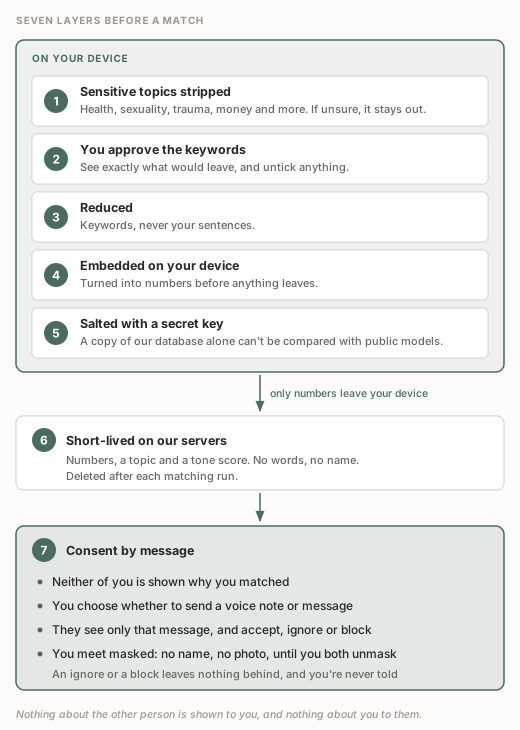
1. Sensitive topics stripped. Some parts of a life should never be the basis for meeting a stranger. These are removed automatically and can never be matched on: suicide and self-harm, health, eating, addiction, sexual life, sexual orientation and gender identity, abuse and trauma, pregnancy and fertility, money, legal matters, immigration, politics, other people’s private details, and anything specific about children. Two independent checks look for them, and either one alone is enough to keep something out. When the system isn’t sure, it keeps it out. Faith can be matched only if you explicitly opt in. Grief can be matched, because shared loss is often exactly what people are looking for.
2. You approve the keywords. In Settings you see the exact keywords that would leave your device. Untick any of them, or a whole topic. Unticking also deletes that data from our servers.
3. Reduced. What’s left is cut down to keywords. Your sentences never leave.
4. Embedded on your device. Those keywords are turned into numbers, an embedding, on your own device. The words themselves stay behind.
5. Salted with a secret key. Before the numbers are stored, they’re transformed with a secret key. More on why below.
6. Short-lived on our servers. What arrives is a set of salted numbers, a topic category and a tone score. No words, no name. It’s used for a matching run and then deleted. You can pause matching whenever you like, and delete your matching data on demand.
7. Consent by message. When you’re matched, you see why from your own memory, on your device. The other person is shown nothing, and nothing about them is shown to you. You can choose to send them a voice note or a message. They see only that, and decide whether to accept. If they ignore or block it, nothing is left behind, and you’re never told. If they accept, you both stay masked, with no name and no photo, while the connection builds. Unmasking only happens when you both choose it.
Why the secret key matters. Embeddings are made by models anyone can download. Plain embeddings, left as they are, could be lined up against those public models by anyone who got hold of a copy. So yours are never stored plain. Each one is transformed with a secret key first. Matching still works inside algn’s matching system, but a copy of our database on its own can’t be compared against public models. It’s one more layer between a stolen copy and your life.
No layer here works alone. Stripping keeps the most personal parts of your life from ever becoming numbers. Your approval keeps the rest in your hands. Reduction and the secret key keep what leaves small and bound to algn. Deletion keeps it short-lived. And the last layer isn’t technology at all. It’s a person’s choice.
Layer 6 · Your choice
Nothing about you crosses to another member unless you decide it should. You choose whether to reach out after a match. They choose whether to answer. And even then, you meet masked: no name, no photo, just the conversation. You stay that way while the relationship builds, and you unmask only if you both want to. Either of you can walk away at any point and leave no trace.
When you do talk, messages and voice notes between members are end-to-end encrypted. Content is sealed with AES-256-GCM, keys are exchanged with RSA-OAEP, and the private keys stay on members’ own devices. Our servers hold messages only as encrypted blobs, long enough to deliver them, and can’t read them.
Your account
algn is locked behind a passkey or your device’s biometrics, set up when you join, so an unlocked phone isn’t enough to open it. algn is for adults: you give your date of birth, and anyone under 18 is blocked.
A small amount of data does live on our servers, because the platform can’t run without it. It’s tied to an account, not to your name, and every item is there for a reason.
ON OUR SERVERS (pseudonymous, tied to your account) · Account, sign-in, age declaration, settings · Membership level, credits and points · Activity pattern for contribution (when, not what) · Matching data: salted numbers, a topic, a tone score. Short-lived, deletable · Member messages as ciphertext for delivery · Tone baseline numbers, if switched on. Encrypted, deletable
NEVER ON OUR SERVERS · Your memory vault · Your conversation history · Audio recordings · Voiceprints · Private keys for messaging
The design is built against privacy law in the UK, the EU, the US, Canada and Australia. Sera tells you it’s an AI the first time you use it, and the tone-and-energy feature is explained before you choose it, as the EU AI Act requires. This website uses cookieless analytics, with no cross-site tracking and no fingerprinting, which is why you haven’t seen a cookie banner.
If something goes wrong
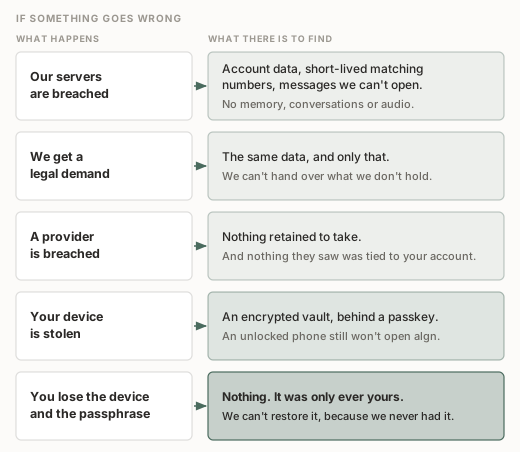
Layers are only worth something if they hold on a bad day. Here’s what each of these scenarios would find.
Checking for yourself
You shouldn’t have to take any of this on trust, so you don’t have to.
- Your backup: open the inspect view and look at the raw file: header, size, fingerprint, ciphertext.
- Your memory: open the vault, read every memory, delete what you don’t want kept.
- Your matching: see the keywords that would leave, untick them, pause matching, delete your matching data.
- The code: the parts that hold your vault, manage its keys and delete your data are published as an open repository, with a data-flow manifest listing every process, what it receives, which kind of server it goes to, and how long anything is kept.
- Our providers: a sub-processors page lists every company whose servers we use, and their retention terms.
What we chose to give up
Every one of these layers cost us something. We’d make the same choices again.
- No automatic cloud sync: your memory never sits on our servers, so you carry it yourself, in your encrypted backup.
- No recovery from us: we can’t restore your memory, because we never had it.
- Nobody reading along: no one watches your conversations, not even to help. A safety check runs, and no person sees what you said.
- Less to match on: whole parts of life are off limits to matching. That’s what makes it safe to be matched at all.
- Powerful models, reached anonymously: we chose the best open-weight language models and enterprise speech servers, reached as algn and under zero data retention, over weaker ones we could run ourselves. You deserve good conversation and privacy, not one or the other.
Corrections
This page is stable. We don't expect it to change much, but we still fix what we get wrong. If a claim looks off or a source doesn't hold up, tell us below.