Why does everyone feel overwhelmed all the time?
In 2018, 74% of UK adults said they had felt overwhelmed or unable to cope at some point in the past year (Mental Health Foundation). That is one survey, not a trend. But several long-running measures of connection, opportunity and trust all moved the same way over the same decades. This is the report's reading of what they describe together.
Several things got harder at the same time
Most explanations settle on a single cause. The data points somewhere else.
Across studies that rarely compare notes, the same direction appears. The share of Americans earning more than their parents at age 30 dropped from about 92% for those born in 1940 to about 50% for those born in the 1980s (Raj Chetty and colleagues, Science, 2017). Americans aged 15 to 24 spent about 70% less time with friends in person in 2020 than in 2003 (US Surgeon General’s advisory, 2023). The share of Americans with no close friends rose from 3% to 17% between 1990 and 2024 (Gallup, 1990; Cox and Pressler, Disconnected, 2024). Time on a single screen at work before switching fell to about 47 seconds by 2016 to 2021, from about two and a half minutes in 2004 (Gloria Mark, Attention Span, 2023).
Trust in institutions also declined. Trust in the US federal government fell from 77% in 1964 to 17% in September 2025 (Pew Research Center). These data do not show whether one change caused another. But they all moved in the same direction, over the same decades. The report reads these changes happening together as the background against which everyday stress builds up. No dataset here measures overwhelm itself.
What happens when stress does not switch off
The body’s stress system is built for threats that arrive and pass. A signal comes in, the body mobilises, the signal goes, and systems reset. When the reset never finishes, the wear adds up. Bruce McEwen and Eliot Stellar (Archives of Internal Medicine, 1993) called this allostatic load.
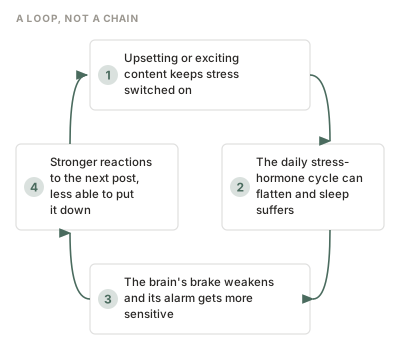
When stress does not stop, the body’s daily stress-hormone cycle can flatten: a smaller morning peak, higher evening levels (Gregory Miller, Edith Chen and Eric Zhou, Psychological Bulletin, 2007). Sleep suffers. A review of more than 125,000 children and young people across 20 studies found that bedtime screen use was associated with roughly double the odds of not sleeping enough (Ben Carter and colleagues, JAMA Pediatrics, 2016). Poor sleep weakens the part of the brain that manages impulse and planning, while making the part that reacts to threat more sensitive (Adam Krause, Matthew Walker and colleagues, Nature Reviews Neuroscience, 2017).
That can create a loop. Worse sleep means stronger reactions to the next piece of upsetting or exciting content, and less ability to set it down. Established studies support each step in this loop. No study has tested the loop across a whole population.
Why the pattern is hard to see from inside
This is the report’s reading, developed further in The Invisible Cage.
To notice something this big, a society needs a few things. Attention that lasts. People it trusts. Close ties. Time to think.
Those are the exact measures in decline.
No Pew reading of trust in the federal government has risen above 30% since 2008. Gallup’s confidence data across institutions shows the same shape: each downturn since the 1970s has bottomed out lower than the last, with recoveries that have rarely got back to the previous peak. The institutions that used to generate friendships through shared activity, community organisations, religious congregations, local clubs, are themselves smaller than they were (Robert Putnam, Bowling Alone, 2000; AmeriCorps, Civic Engagement and Volunteering survey).
The things you would need to step back and see the full picture are the same things the pattern is wearing down.





The things you would need to step back and see the full picture are the same things the pattern is wearing down.
Where the evidence is thin
Most of this data comes from the US. Long-run series that ask the same questions in other countries are scarce. Researchers genuinely disagree about whether smartphones and social media caused the decline in young people’s mental health (Jonathan Haidt, The Anxious Generation, 2024; Candice Odgers, Nature, 2024). No study has measured whether the proposed stress loop runs at the scale of a whole population.
The numbers measure real things: earnings, friendships, attention, trust. They come from named studies across named decades. What they do not yet tell us is how much each one weighs.
Where the numbers come from
- 74% of UK overwhelmed or unable to cope at some point, Mental Health Foundation, 2018. https://www.mentalhealth.org.uk/about-us/news/survey-stressed-nation-UK-overwhelmed-unable-to-cope
- Raj Chetty et al., The Fading American Dream: Trends in Absolute Income Mobility Since 1940, Science, 2017. https://doi.org/10.1126/science.aal4617
- Our Epidemic of Loneliness and Isolation, US Surgeon General, 2023.
- Gallup News Service Poll: January 1990, Wave 2, Gallup Organization, Roper Center for Public Opinion Research, 1990. https://doi.org/10.25940/ROPER-31088676
- Daniel Cox and Samuel Pressler, Disconnected: The Growing Class Divide in American Civic Life, Survey Center on American Life, 2024.
- Gloria Mark, Attention Span, Hanover Square Press, 2023.
- Public Trust in Government: 1958-2025, Pew Research Center, 2025.
- Confidence in Institutions, annual series, Gallup, 2026. https://news.gallup.com/poll/1597/confidence-institutions.aspx
- Bruce McEwen and Eliot Stellar, Stress and the Individual, Archives of Internal Medicine, 1993. https://doi.org/10.1001/archinte.1993.00410180039004
- Gregory Miller, Edith Chen and Eric Zhou, If It Goes Up, Must It Come Down? Chronic Stress and the Hypothalamic-Pituitary-Adrenocortical Axis in Humans, Psychological Bulletin, 2007. https://doi.org/10.1037/0033-2909.133.1.25
- Ben Carter et al., Association Between Portable Screen-Based Media Device Access or Use and Sleep Outcomes, JAMA Pediatrics, 2016. https://doi.org/10.1001/jamapediatrics.2016.2341
- Adam Krause, Matthew Walker et al., The sleep-deprived human brain, Nature Reviews Neuroscience, 2017. https://doi.org/10.1038/nrn.2017.55
- Robert Putnam, Bowling Alone, Simon & Schuster, 2000.
- Civic Engagement and Volunteering survey, AmeriCorps and US Census Bureau, 2021.
- Jonathan Haidt, The Anxious Generation, Penguin Press, 2024.
- Candice Odgers, The great rewiring: is social media really behind an epidemic of teenage mental illness?, Nature, 2024. https://doi.org/10.1038/d41586-024-00902-2
Most of the long-running data is from the US.