Do we really have a goldfish attention span?
No. The claim that human attention dropped to eight seconds comes from a website called Statistic Brain, repeated in a 2015 Microsoft Canada report. When the BBC traced the sources, none of them backed the figure (Simon Maybin, BBC, 2017). The goldfish side has no research behind it either.
Where the eight-second number came from
Microsoft Canada published a report in 2015 that included a chart citing Statistic Brain as its source for the claim that human attention spans had fallen from 12 seconds in 2000 to eight seconds in 2013. Statistic Brain listed a US government science database and the Associated Press as its sources. Neither could point to any research supporting the figures (Maybin, BBC, 2017).
The figure spread through Time, the Telegraph, the Guardian, USA Today and the New York Times. The BBC found no study behind it (Maybin, BBC, 2017).
So the headline number is not real. That does not mean nothing has changed.





So the headline number is not real. That does not mean nothing has changed.
What has actually been measured
Gloria Mark, a professor who studies how people use computers at the University of California, Irvine, ran a series of studies tracking how long office workers stayed on a single screen before switching to another. In 2004, the average was about two and a half minutes. By 2012 it was about 75 seconds. Across studies run between 2016 and 2021, it fell to roughly 47 seconds (Mark, Attention Span, 2023).
These are separate studies with different people, not one group followed over time. They used similar methods and they all point the same way.
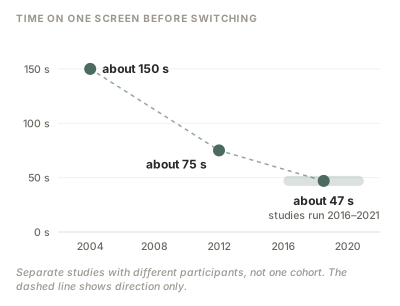
47 seconds is not “attention span” in the way a headline means it. It is how long someone at work looked at one screen before switching. The difference matters. A person watching a two-hour film or reading a book is holding focus for far longer. Mark’s data measures something narrower: how long people at work stay on one screen before switching. That number has dropped sharply.
Why this is hard to pin down
Attention is not a single thing you can time with a stopwatch. How long you can focus on a book is a different question from how well you can block out a conversation next to you, which is different again from how you juggle tasks at a desk. A measure of screen-switching tells you about what people do in a particular setting. It does not tell you whether your brain can actually focus less than it used to.
Mark puts the pattern down to a mix of interruption, habit and the way screens are designed. They are built to pull you away. Notifications arrive, feeds refresh, and every page holds a link to something else. Over time, switching becomes the habit rather than the exception.
The link between these changes in how people act and deeper changes in the brain is plausible. No one has tested it directly. The Pattern Beneath the Symptoms, algn’s report on nine pressures building at the same time, notes this as a gap: the pattern of people switching tasks more often is strong, but whether it means people can actually focus less is still an open question.
The numbers people search for
The most common searches around this topic ask for a single figure: “What is the average human attention span?” There is no honest single figure to give. The eight-second claim has no source behind it. Mark’s 47-second screen-switching measure is real but narrow. And the bigger question, whether people really can focus less than they used to, does not yet have a clean answer.
The data does show that the setting has changed. The average time on one screen at work dropped from about 150 seconds to about 47 seconds in under two decades (Mark, Attention Span, 2023). That is a measured change in what people do, with named data, in a specific place. It is not the same as saying human attention broke.
Honest answers are less tidy than myths. This one is worth knowing.
Where the numbers come from
- Gloria Mark, Attention Span, Hanover Square Press, 2023.
- Simon Maybin, Busting the attention span myth, BBC World Service, More or Less, 2017. https://www.bbc.com/news/health-38896790
- Attention Spans: Consumer Insights, Microsoft Canada, 2015.
Most of the long-running data is from the US.