Is there really a loneliness epidemic?
The decline is real, but uneven. The share of Americans with no close friends rose from 3 per cent in 1990 to 17 per cent in 2024 (Survey Center on American Life). People with less education are hit hardest. "Epidemic" overstates what the data show.
The numbers behind the headline
The US Surgeon General called it an epidemic in 2023. Headlines treat loneliness as the health crisis of our time.
But what do the numbers say?
The Survey Center on American Life has tracked American friendships since comparing its 2021 survey with a 1990 Gallup starting point. In 1990, 3 per cent of Americans said they had no close friends. By 2021, that was 12 per cent. By 2024, 17 per cent. The 1990 and later surveys used different methods, which may make the change look bigger than it is. The later surveys point the same way.
At the other end, 33 per cent of Americans reported ten or more close friends in 1990. By 2021, that had dropped to 13 per cent.
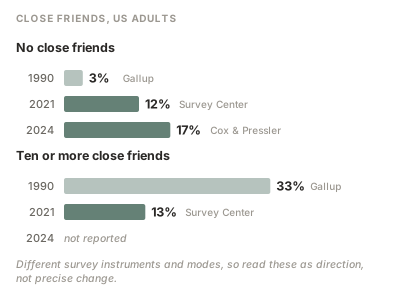
The drop is real. But it is not hitting everyone equally.
Who is actually affected
The 2024 data from Daniel Cox and Samuel Pressler shows a sharp split by education. Among Americans with a high-school education or less, 24 per cent reported no close friends. Among university graduates, 10 per cent.
Men have lost ground faster than average. In 1990, 3 per cent of American men reported no close friends. By 2021, that was 15 per cent, according to the Survey Center on American Life’s analysis of the same data.
Young Americans now spend far less time with friends. The Surgeon General’s 2023 report, drawing on the American Time Use Survey, found that Americans aged 15 to 24 spent about 70 per cent less time in person with friends in 2020 than in 2003. Time spent alone rose across the population.
These numbers measure friendship, not loneliness itself. The two are related but not the same. You can lose close friends without feeling lonely, at least for a while. But the friendship numbers are heading one way.




These numbers measure friendship, not loneliness itself.
Why it matters for health
The health evidence is separate from the question of whether loneliness is rising, and it is strong.
Julianne Holt-Lunstad and colleagues, in a 2015 review of 70 studies, found loneliness linked to a 26 per cent higher risk of early death. Nicole Valtorta and colleagues found poor social relationships tied to 29 per cent higher risk of coronary heart disease and 32 per cent higher risk of stroke (2016). The Surgeon General’s report brought these together and added higher dementia risk in older adults.
So the stakes are real. The question is who they hit.
What the data do not say
Most of the long-run data comes from the US. The Surgeon General’s friendship figures, the Survey Center’s surveys and the American Time Use Survey are all American. Similar long-run surveys for the UK, Australia and other countries are hard to find. When you see a UK headline quoting the same numbers, check the source. It is probably American.
The data also cannot settle why. The friendship decline started before smartphones. Working hours, people moving for work, the decline of religious groups and community organisations are all possible reasons, but no one has proved which causes it. Platforms make contact cheap but compete for the same time that deeper relationships need.
And “epidemic” is a word from infectious disease. Using it shapes how people think about the problem.
Where this leaves us
The friendships are thinning. The health risks are documented. The cause is not one thing. And the 2024 data shows people with a high-school education or less hit hardest.
Calling it an epidemic makes a good headline. The data tell a quieter, more uneven story.
Where the numbers come from
- Daniel Cox, The State of American Friendship: Change, Challenges, and Loss, Survey Center on American Life, 2021. https://www.americansurveycenter.org/research/the-state-of-american-friendship-change-challenges-and-loss/
- Daniel Cox, Men's Social Circles are Shrinking, Survey Center on American Life, 2021.
- Daniel Cox and Samuel Pressler, Disconnected: The Growing Class Divide in American Civic Life, Survey Center on American Life, 2024.
- Gallup News Service Poll: January 1990, Wave 2, Gallup Organization, Roper Center for Public Opinion Research, 1990. https://doi.org/10.25940/ROPER-31088676
- Our Epidemic of Loneliness and Isolation, US Surgeon General, 2023.
- Julianne Holt-Lunstad et al., Loneliness and Social Isolation as Risk Factors for Mortality, Perspectives on Psychological Science, 2015. https://doi.org/10.1177/1745691614568352
- Nicole Valtorta et al., Loneliness and social isolation as risk factors for coronary heart disease and stroke, Heart, 2016. https://doi.org/10.1136/heartjnl-2015-308790
Most of the long-running data is from the US.