How many close friends do most people have?
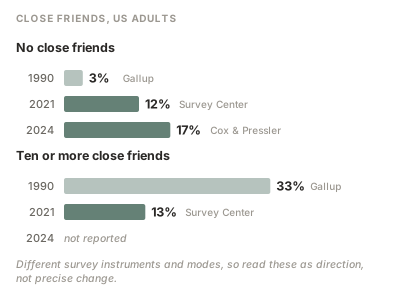
There is no single number. Robin Dunbar's research puts the innermost circle at roughly five people, though even that figure is debated. What three national surveys show is a direction: the share of Americans reporting no close friends rose from 3 per cent in 1990 to 12 per cent in 2021 and 17 per cent in 2024 (Gallup, 1990; Survey Center on American Life, 2021 and 2024). The later surveys all point the same way.
Fewer close friends, and fewer people with any
The Gallup Organization asked the question in 1990. The Survey Center on American Life asked again in 2021 and 2024, each time with a new group of people across the country.
In 1990, 33 per cent of Americans said they had ten or more close friends. By 2021 that had fallen to 13 per cent. At the other end, the share reporting none rose from 3 per cent to 12, then to 17 per cent in the most recent survey (Daniel Cox and Samuel Pressler, Disconnected, Survey Center on American Life, 2024).
The drop is not evenly spread. In 2024, 24 per cent of Americans with a high-school education or less reported no close friends, compared with 10 per cent of university graduates. Among men, the share with none rose from 3 per cent in 1990 to 15 per cent by 2021 (Daniel Cox, Survey Center on American Life, 2021).
One note on the data. The 1990 and 2021 surveys were run differently, which may exaggerate the change. The size of the change is uncertain; the later surveys point the same way.
Are people spending less time together?
The surveys match how Americans actually spend their days. The Surgeon General’s report on social connection (2023), using data from the American Time Use Survey, found that Americans aged 15 to 24 spent about 70 per cent less time with friends in person in 2020 than in 2003. Time spent alone rose across the population.
Robin Dunbar’s research (from 1993 onward) suggests that human social networks sit in layers, one inside the next: roughly five people in the innermost circle, then about 15, 50, and 150. The exact numbers are debated. Patrik Lindenfors and colleagues re-checked the data behind 150 and found the range so wide that no single number holds up (2021). What survives is the layered structure and the simple fact that relationships take time. Close friendships sit in the smallest circle. They need the most time per person, and there is a limit on how many anyone can keep up.





Close friendships sit in the smallest circle.
Why the number keeps falling
The decline started before smartphones. Longer working hours and more frequent moves between cities are possible reasons, though no one has proved which matters most. So is the slow disappearance of the groups that once created friendships through shared activity. Robert Putnam documented a long decline in American clubs, leagues and congregations in Bowling Alone (2000): the settings where new friendships formed have been emptying out.
No single cause explains it. That is, in some ways, the point. A friendship takes regular time in the same place with the same person. Several of the forces reshaping American life over the last thirty years may have worked against exactly that.
Friendship shapes more than private life. Daniel Cox (Survey Center on American Life, 2023) found that 60 per cent of Americans with six or more close friends had attended a local event or community meeting at least a few times in the past year. Among those with none, 33 per cent had. People with fewer friends take part less in local life. Which one drives the other is not yet known.
The data in this post is American. Similar long-running surveys about friendship in other countries are hard to find. That is itself worth noting.
Where the numbers come from
- Gallup News Service Poll: January 1990, Wave 2, Gallup Organization, Roper Center for Public Opinion Research, 1990. https://doi.org/10.25940/ROPER-31088676
- Daniel Cox, The State of American Friendship: Change, Challenges, and Loss, Survey Center on American Life, 2021. https://www.americansurveycenter.org/research/the-state-of-american-friendship-change-challenges-and-loss/
- Daniel Cox, Men's Social Circles are Shrinking, Survey Center on American Life, 2021.
- Daniel Cox, America's 'Friendship Recession' Is Weakening Civic Life, Survey Center on American Life, 2023.
- Daniel Cox and Samuel Pressler, Disconnected: The Growing Class Divide in American Civic Life, Survey Center on American Life, 2024.
- Our Epidemic of Loneliness and Isolation, US Surgeon General, 2023.
- Robin Dunbar, Coevolution of neocortical size, group size and language in humans, Behavioral and Brain Sciences, 1993. https://doi.org/10.1017/S0140525X00032325
- Patrik Lindenfors et al., 'Dunbar's number' deconstructed, Biology Letters, 2021. https://doi.org/10.1098/rsbl.2021.0158
- Robert Putnam, Bowling Alone, Simon & Schuster, 2000.
Most of the long-running data is from the US.